Navigating the Clarity Air Monitoring Dashboard

We have partnered with Clarity Movement, a low-cost air sensor company. These air monitors allow us to get real-time air quality data and analyze it using the associated Clarity dashboard. Here you will learn how to navigate that dashboard. 

Localized air monitoring is essential for understanding how air pollution impacts neighborhoods at the local level. When monitors are spaced out at the county level, we cannot see how pollutants may be affecting certain neighborhoods within a county. Studies show that the burden of air pollution exposure more often falls on neighborhoods populated by lower income people of color.

Table of Contents

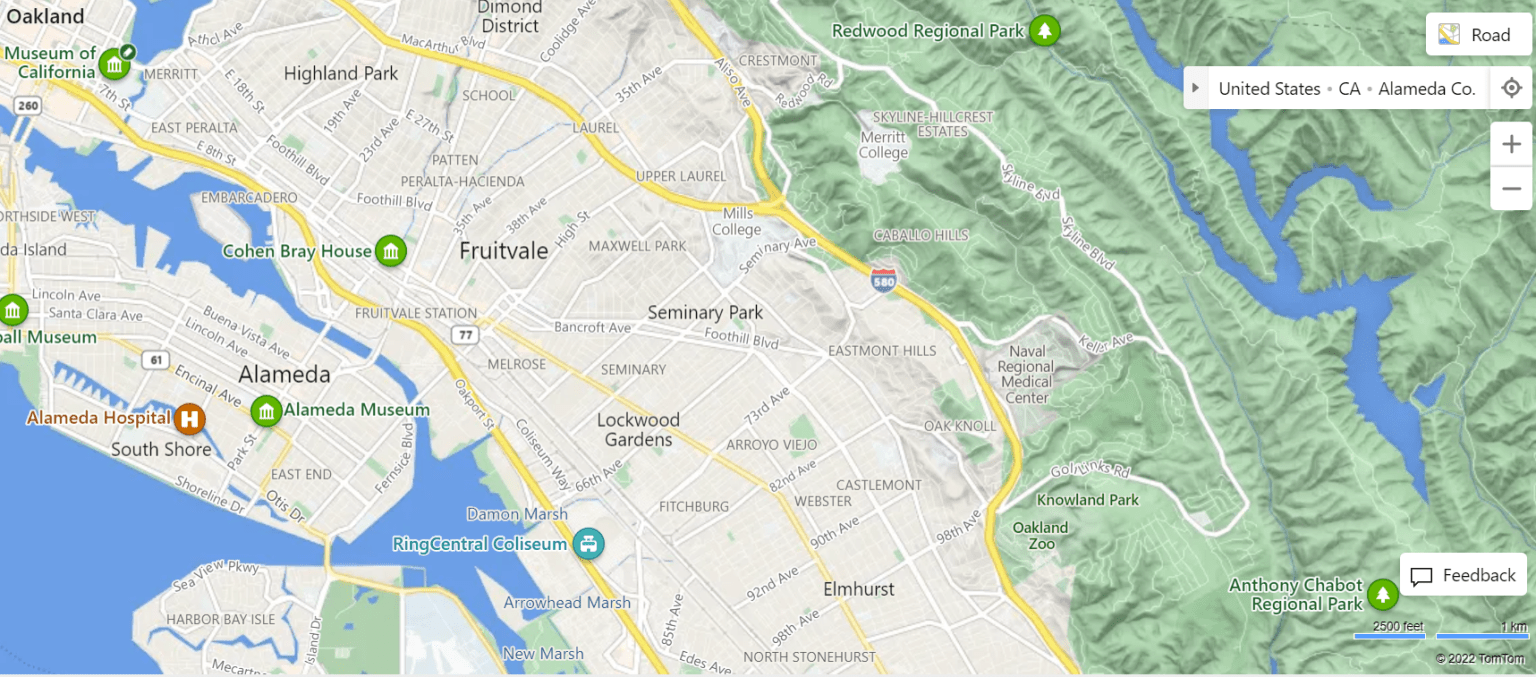
These monitors collect real-time air quality data every 5 minutes! We have deployed 5 air monitors around the East Bay. Below each red dot indicates the location of each monitor. 

We have deployed 6 air monitors around the East Bay. These monitors are collecting real-time air quality data every 5 minutes! Here you can learn how to navigate the Clarity Air Monitoring Dashboard. This page is best suited to desktop view. 

The monitors collect a measurement every 5 minutes. They are solar-powered and upload data using a local cellular signal, so even in an extreme weather event or power outage, they will still collect data!

The monitors are solar-powered and upload data using a local cellular signal, so even in an extreme weather event or power outage, they will still collect data!

Bay Area Technology School

Brookfield Elementary School

Skyline, outside security gate 

Skyline, inside class 105 

Skyline, inside classroom 20
Working with the data (BASIC)

For students unfamiliar with statistical analysis and wanting to use photos of the data to support their capstone research 

Helpful research questions to use in the classroom

1. How do air quality trends change depending on the topography (forms and features of the land) of a place? Reference 3-5 places around the world to show the role that topography plays in air quality 

2. How does a particular time of year affect air quality trends? Pick two places at two different times of year, and see how they change. 

3. How does the political and/or cultural landscape of a place affect their air? Choose 2-4 different locations around the world and compare their air quality in relation to their political/socio-cultural landscape 

You need your Clarity login to access this section. If you haven’t received a login yet, let us know here! This section is best for students familiar with statistical analysis. 

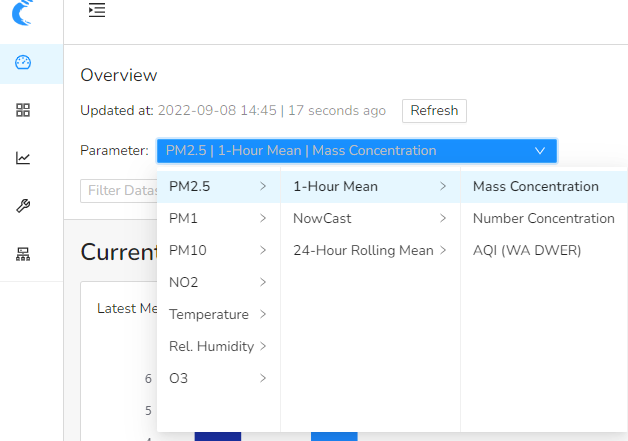
1. Choose your parameters (what measurements to select). PM 2.5 is the most commonly studied and easily measurable pollutant, so the recommended parameter is PM 2.5 + 1 hour mean + mass concentration.

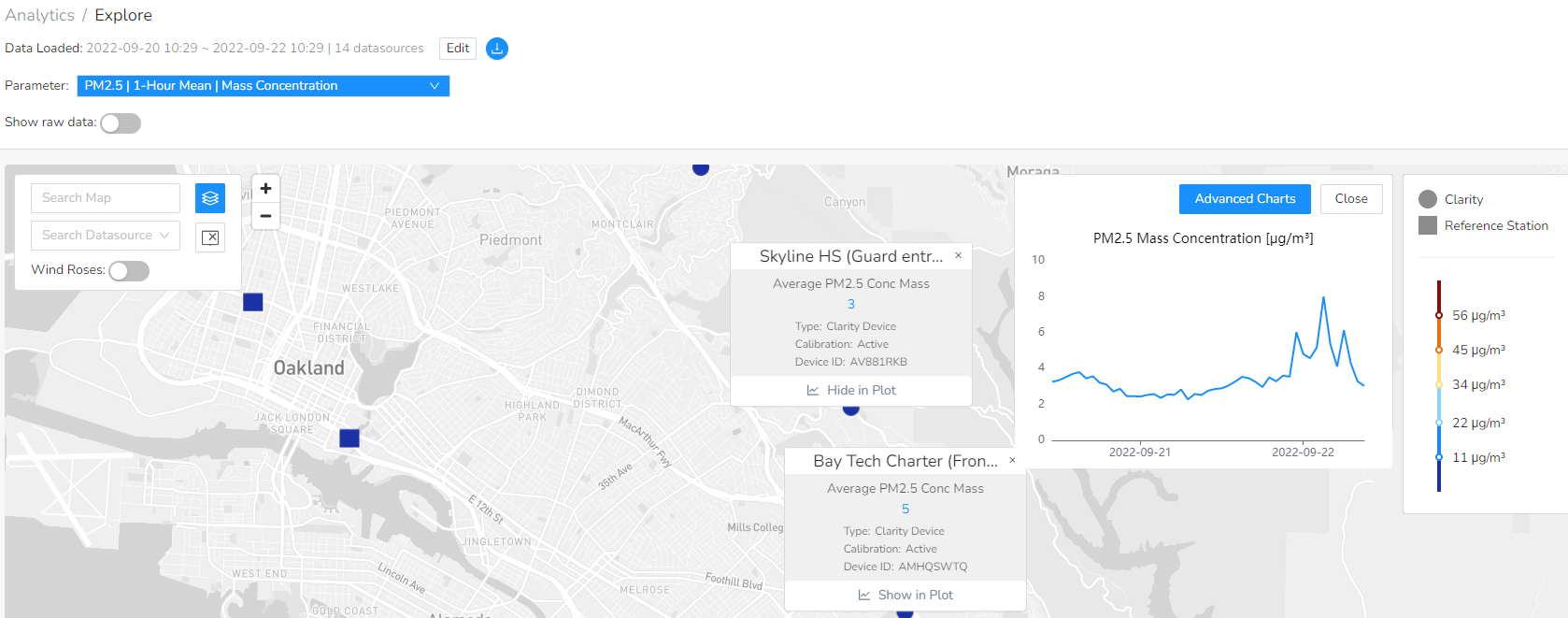
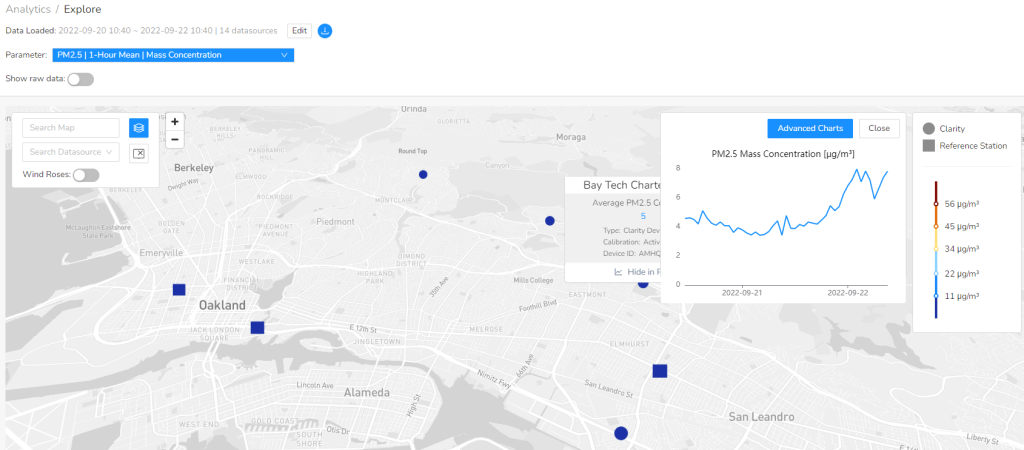
2. Under the Analytics tab on the left you can use Explore to view the different monitors on the map. The squares and circles represent the clarity monitors (circles) and the reference monitors (squares). Hover over which monitor you want to view, and select “Show in Plot.” You can also select multiple monitors to view in the same graph- repeat the process to do so. 

The squares on the map are non-clarity monitors used as reference sites. If you include both kinds of devices in your analysis, be sure to indicate which monitors’ data you are referencing. 

3. After selecting “show in plot” you can then view “advanced charts” to see the different ways to visualize the data

what does this do?

Download the monitor data here into a CSV file. 

what does this do?

Download the monitor data here into a CSV file. 

what does this do?

Keep this unselected. The raw data is uncalibrated and inaccurate 

what is this measuring?

The mass concentration uses the unit micro grams per meter cubed. 
The squares on the map are non-clarity monitors used as reference sites. If you include both kinds of devices in your analysis, be sure to indicate which monitors’ data you are referencing. 

Interpreting the data

Time Series

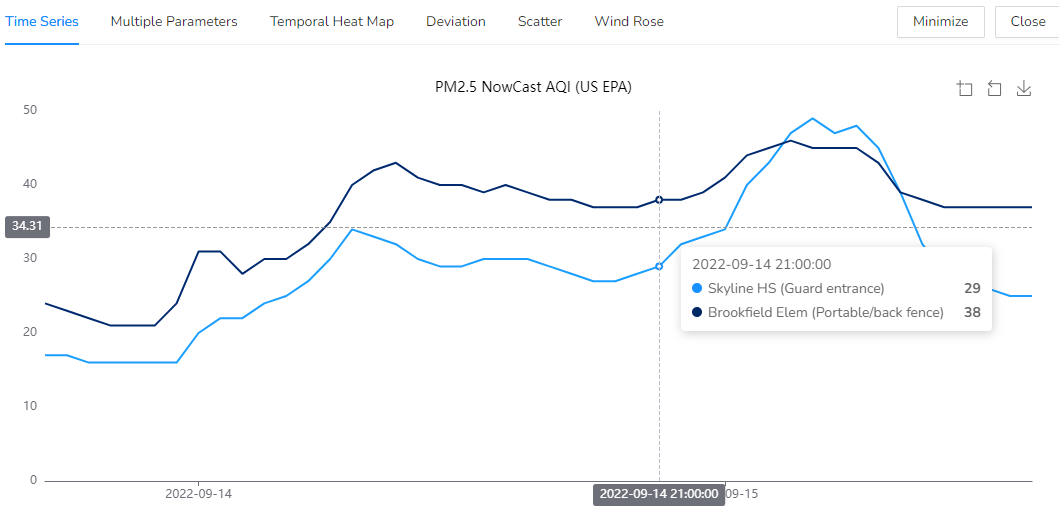
X-axis is time and the Y-axis is AQI. We see two lines here because there are two monitors' measurements being compared.

Research question: Pick a significant date or time of day and assess the air quality across two or more monitors. How are they alike and how are they different?
Multiple Parameters

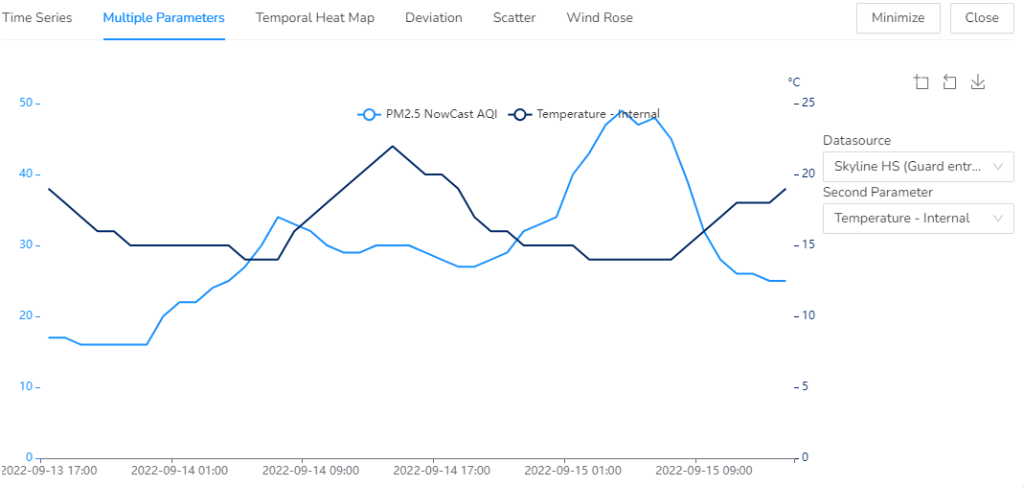
X-axis is time (data and hour), and the Y-axis has two different measurements, comparing temperature in celcius on the right, to AQI on the left.

Research question: How does heat collect in different areas of the East Bay, in relation to the air quality? Are there other factors that may affect how the heat and poor air quality relate to one another within a specific location?
Temporal Heat Map

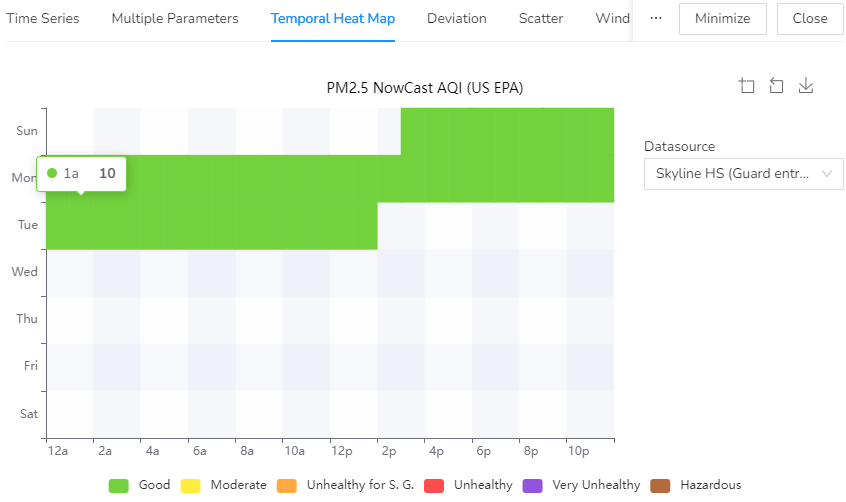
X-axis is time (hour), and the Y-axis is day of the week.
The color blocks indicate how the air quality shifts across the different categories of air quality from good to hazardous, symbolized with colors.

Research question: During a wildfire event, what are the major differences we see in air quality over the course of a week, comparing two different neighborhoods and the factors that may affect those differences?
You may need to reference other data if there has not been a recent local wildfire event.

The two graphs below are more advanced if you’re up for a challenge!

Scatter

For this graph, be sure to choose two different monitor locations to plot. Select on for the x axis, and one of the y axis). This will compare how much the two locations differ in air quality from one another over

Research question: What two monitors are most similar to each other and what two are most different? What might explain these similarities and differences?
Deviation

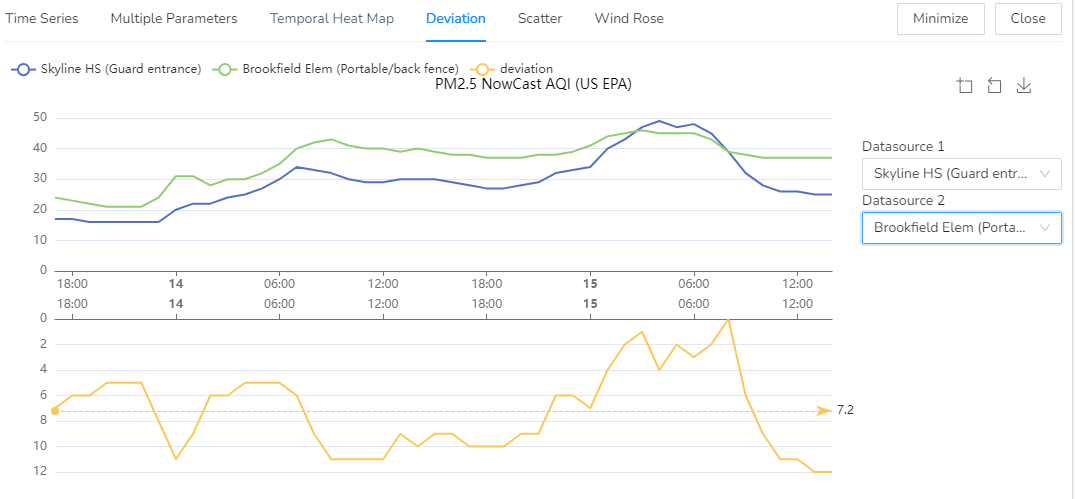
This graph is best used with data from more than one monitor. On the x axis is time in hours, and on the y axis is AQI, but below is a range from 0-1 which will indicate on the graph, to what extent (by %) is the air quality shifting over the course of a day.

Submit your questions and feedback here!